October 2026–present
PhD, Applied Mathematics & Theoretical Physics
University of Cambridge
Supervised by Miles Cranmer and Alessandro Favero. AI interpretability for language models and scientific foundation models.
Department of Applied Mathematics and Theoretical Physics, University of Cambridge
I’m a PhD student in the Department of Applied Mathematics and Theoretical Physics at the University of Cambridge, supervised by Miles Cranmer and Alessandro Favero.
I’m interested in how neural networks represent knowledge, and how understanding their internal computations can help us progress science and create more aligned AI. I currently work on mechanistic interpretability of language models and scientific foundation models. I also wish to contribute to more aligned AGI through my interpretability research.
Previously, I studied for an MPhil in Data Intensive Science at Cambridge, and worked at ESA, Intel, and INRIA.

October 2026–present
University of Cambridge
Supervised by Miles Cranmer and Alessandro Favero. AI interpretability for language models and scientific foundation models.
2025–2026
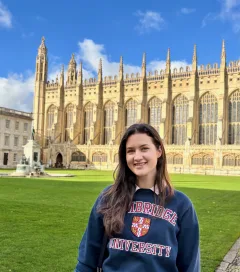
University of Cambridge, King’s College
Distinction. King’s College scholarship recipient. Machine learning, deep learning, statistics, research computing, agentic systems, and reinforcement learning.
2020–2024
Polytechnic University of Timișoara, Romania
Computer science, software engineering, artificial intelligence, simulation methods, and algorithms. Bachelor’s thesis in collaboration with ESA.
July 2026–present
DAMTP, University of Cambridge, United Kingdom
Interpretability and knowledge-editing methods for LLMs and scientific foundation models, including Walrus, and model-internal algorithmic representations.
July–September 2025
European Space Agency, Madrid, Spain
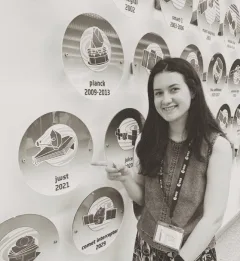
Created a dataset of approximately 600,000 galaxy images from JWST observations. Applied semi-supervised active learning to identify more than 35 new galaxy–galaxy gravitational lens candidates.
July 2024–July 2025
Intel, Timișoara, Romania
Optimised compilation and runtime for more than 50 model architectures on Intel’s Neural Processing Unit. Integrated over 20 generative AI models on low-power NPUs, using C++, Python, OpenVINO, LLVM, and ONNX.
June–September 2023
European Space Agency, Madrid, Spain
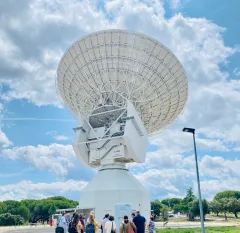
Extended HILIGT, the High-energy Light-curve Generator, to compute historical X-ray fluxes and upper limits using data from more than five space missions, including ASCA, NuSTAR, and Chandra.
September 2023–January 2025
Polytechnic University of Timișoara
Example classes in Artificial Intelligence Fundamentals, Data Mining, and Modelling & Simulation. Topics included classical machine learning, neural networks, CNNs, Bayesian networks, and NLP.
Using semi-supervised learning and human feedback to search JWST NIRCam observations for gravitational lenses.
A dataset of 1,000 hand-annotated images and an instance segmentation approach for detecting optical artefacts in XMM-Newton observations.
Exploring constraint optimisation to model fairness in support vector machine classifiers, with applications to real-world datasets.
Outside my research (or a bit further away from it), I’m interested in philosophy and neuroscience. I’m the AI Safety Lead for the Cambridge Criminology Society. I enjoy exploring the morality of AI and what it means to build systems that align with human values.